
ヤビク・エンリケ・ユウジ
Second Skin
会場 : アニエスベー ギャラリー ブティック
東京都港区南青山5-7-25 ラ・フルール南青山2F
会期:2026年11月21日(土) - 2027年1月24日(日)
時間:12:00 - 19:00
休廊日:月曜日(11月23日、1月11日除く)
冬季休暇:12月28日(月) - 1月8日(金)
デザイン:ヤビク・エンリケ・ユウジ、Azone+Associates
会場設営:LIFE LIVE
本展に関するお問い合わせ先:a.gallery@agnesb.co.jp
会場2階へは階段でのご案内となります。ご不便をおかけいたしますが、アクセスが難しい場合はスタッフがお手伝いいたしますので、どうぞお気軽にこちらまでご連絡ください。
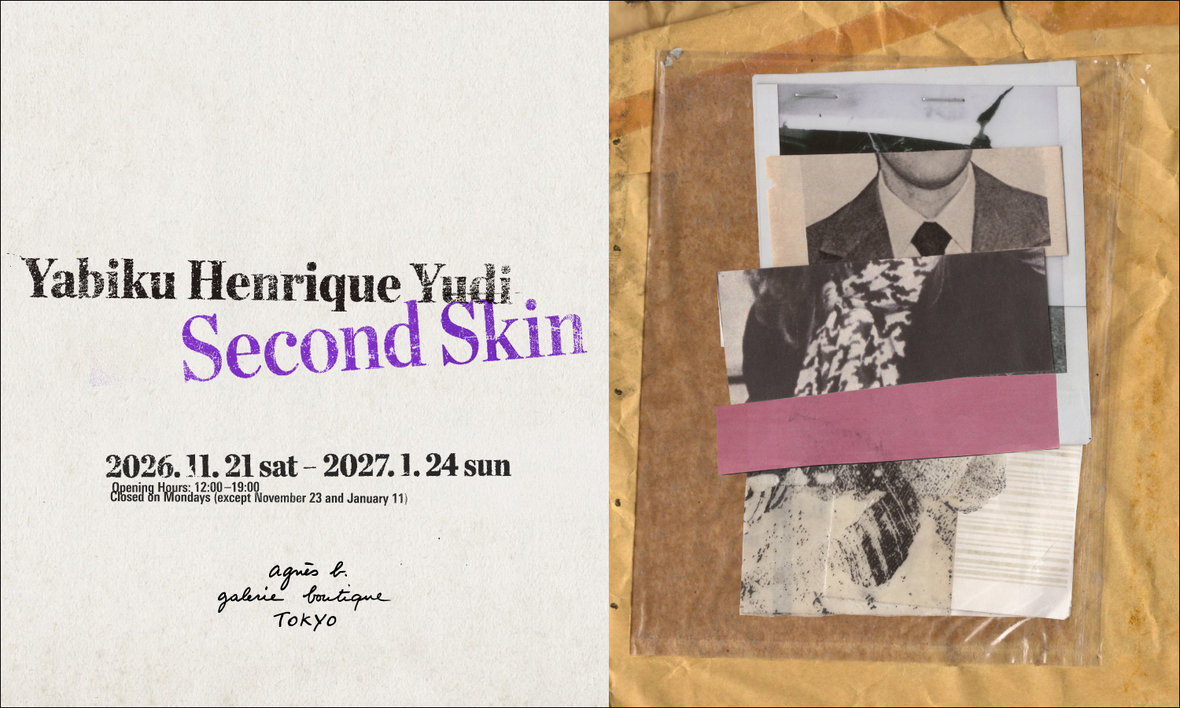
アニエスベー ギャラリー ブティックは、2026年11月21日(土)から2027年1月24日(日)まで、ヤビク・エンリケ・ユウジの個展『Second Skin』を開催いたします。
ヤビクは1997年、日系ブラジル人3世としてサンパウロに生まれ、ブラジルと日本を往来する幼少期を過ごしました。思春期に夢中になったスケートボードを通じて、ストリートカルチャーから大きな影響を受けます。服飾学校でファッションを学んだのち、その関心は古い雑誌の切り抜きを用いたコラージュ制作へと移っていきました。以降、素材は木材やキャンバス、立体印刷による版画へと広がっていますが、コラージュという手法は一貫し、その根底には「DIY、再構成、自由」という姿勢が息づいています。
本展は、ファッションからコラージュへと表現の場を移したヤビクが、改めて衣服をテーマに据えた試みです。衣服を身体と社会のあいだに存在する「第二の皮膚」として捉え、社会や環境との関係のなかで形づくられ、変化していく人間のアイデンティティについて考察します。
衣服は個性を表現する手段であると同時に、社会的な規範や環境に適応し、ときに身体や自己の一部を覆い隠す役割も担っています。しかしどれほど身体を覆っても、その表面には、汗やシミ、皺など、身体と外部環境が触れ合うことで生まれる痕跡が現れます。
ブラジルと日本、二つの社会のあいだで育ったヤビクは、この関係が人間のアイデンティティにも重なると考えます。異なる文化や社会に身を置くとき、人はその環境に適応するために振る舞いや価値観を変えていきます。それは、もう一枚の皮膚をまとうことにも似ています。一方で、完全には馴染みきれない自分自身の性質が無意識に表れることもあれば、適応していく過程で新しい自分が生まれることもあります。つまり「第二の皮膚」は、自己の一部を覆い隠すだけでなく、外部との接触を通じて自己そのものを変えていく存在でもあるのです。
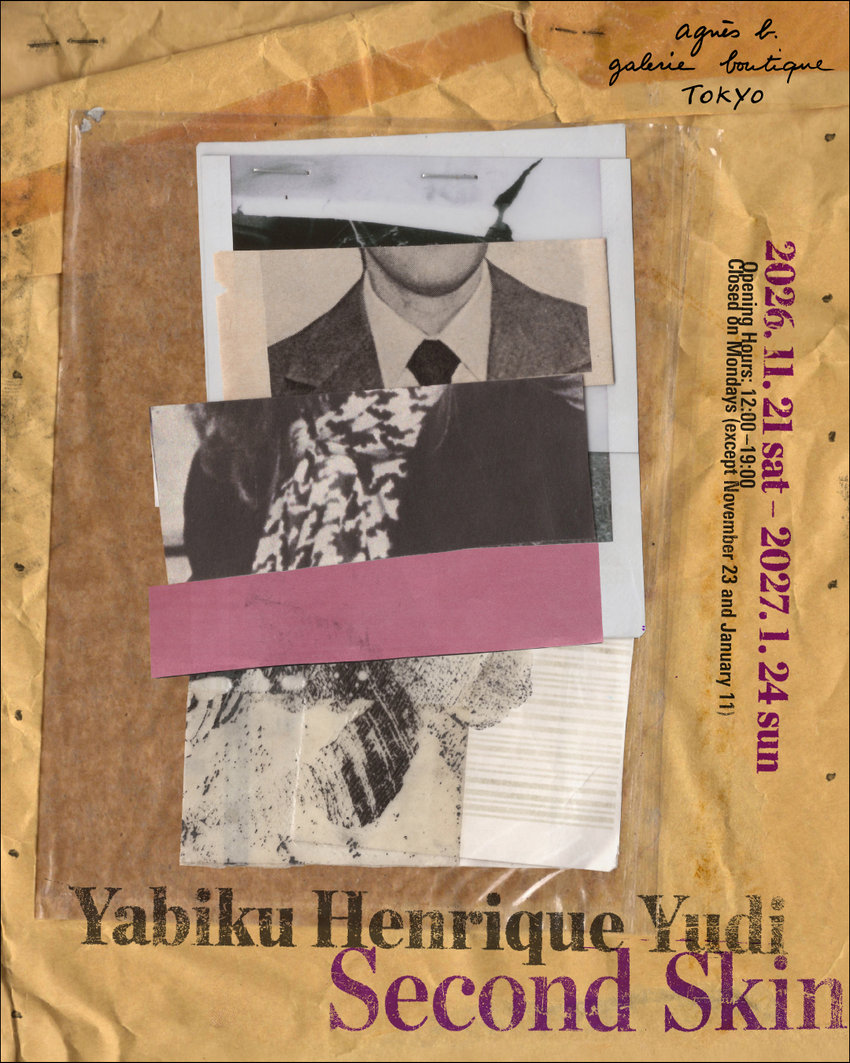
本展の作品は、すべてコラージュの考え方をもとに制作されています。ヤビクは明確な完成像を決めず、異なる背景や文脈を持つ素材を直感的に選び、一つの画面に組み合わせていきます。その過程で、異なる要素は互いに馴染み合うこともあれば、衝突して違和感を残すこともあり、元の性質を保ちながら、周囲との関係によって新たな意味や表情を帯びていきます。素材を重ね、覆い、部分的に露出させるコラージュの構造そのものが、「第二の皮膚」における隠蔽と表出、適応と変容の関係を体現しています。
適応のなかで生まれる痕跡や違和感を、私たちはどのように受け止め、向き合っていくのか。ヤビクは本展を通して、その問いを投げかけます。
アーティストステートメント
今年も、生まれ故郷のサンパウロに帰った。時差ぼけでなかなか眠れず、まだ街が静かな早朝、あるビルの屋上に上がって街を眺めていた。すると、細かな雨が降り始めた。
それは「Garoa (ガローア)」と呼ばれる、サンパウロを象徴する霧雨。降るというよりは、空中を漂うような細かな雨。すぐに濡れるわけではなく、気づかないほどゆっくりと身体に触れ、いつの間にかシャツ全体が湿っていた。
普段は活気にあふれる街も、その時間はまだ車や人の姿が少なく、静けさに包まれていた。そのなかに霧雨や街の匂い、わずかな人の気配が入り混じり、どこか寂しくも、不思議と特別な空気が漂っていた。
その空気に触れ、幼い頃、早朝から親と車で走った霧の中の道の記憶がふと蘇った。懐かしいはずの風景なのに、どこか落ち着かない。それでも、その不思議な空気から目を離せずにいた。
その感覚は、日本に戻ってからも、しばらく自分のなかに残っていた。
あの雨が何かを劇的に変えたわけではない。ただ、知らないうちに湿っていたシャツを見て、そのゆっくりとした変化に、ふと目を向けたような気がした。それが、自分自身やこれまでの作品を、少し違う視点から見つめ直すきっかけになったのかもしれない。
アーティストプロフィール
ヤビク・エンリケ・ユウジ / Yabiku Henrique Yudi
1997年ブラジル・サンパウロ生まれ。ブラジルと日本を往来する幼少期を過ごし、現在は東京を拠点に活動。文化服装学院にて服飾を学んだのち、コラージュを軸とした表現活動を開始する。移動の経験や断片化された記憶、複数の文化の狭間で形成された感覚を制作の基盤とする。印刷物や大量消費されるイメージを引用・再構成し、ダンボールやホチキスなどの日常的・工業的な素材と組み合わせることで、芸術作品と消耗品の境界を曖昧にする。秩序と混沌、美と歪み、愛と憎しみといった二項対立を問い直す。接続と破壊が共存する構造や、変形・再構成が可能な作品形態には、固定化された価値観やアイデンティティに抵抗する姿勢が表れる。時折現れる暴力性やノイズは、不完全な世界に潜む緊張感や美しさを浮かび上がらせる。近年はオブジェクトや空間インスタレーションの制作に加え、ファッションブランドへの作品提供、ヴィジュアル制作、アートディレクションなども手がけ、表現の裾野を広げている。
[English follows]
Yabiku Henrique Yudi
Second Skin
Venue: agnès b. galerie boutique
2F La Fleur Minami-Aoyama, 5-7-25 Minami-Aoyama, Minato-ku, Tokyo
Dates: Saturday 21 November 2025 – Sunday 24 January 2026
Hours: 12:00 – 19:00
Closed: Mondays (except 23 November and 11 January)
Opening Reception: Friday 20 November, 19:00 – 21:00
Design: Yabiku Henrique Yudi, Azone+Associates
Exhibition Setup: LIFE LIVE
Contact: a.gallery@agnesb.co.jp
*Access to the second floor of the venue is via stairs only. We apologise for any inconvenience this may cause. If you require assistance, our staff are here to help—please do not hesitate to contact us.
agnès b. galerie boutique is pleased to present “Second Skin”, a solo exhibition by Yabiku Henrique Yudi.
Born in São Paulo in 1997, Yabiku is a third-generation Japanese Brazilian who spent his childhood moving back and forth between Brazil and Japan. As a teenager, he developed a passion for skateboarding, through which he was deeply influenced by street culture. After studying fashion at college, he turned his attention to making collages from cuttings of old magazines. Since then, his materials have expanded to include wood, canvas and 2.5D prints, yet collage has remained his constant method, underpinned by an ethos of “DIY, reconstruction and freedom”.
This exhibition sees Yabiku return to clothing as a subject for the first time since moving from fashion to collage. Approaching clothing as a “second skin” that exists between the body and society, he reflects on human identity as something shaped and transformed through its relationships with society and the environment.
Clothing is a means of expressing individuality, but it also serves to help us adapt to social norms and our surroundings, and at times to conceal parts of the body or the self. Yet however much the body is covered, traces emerge on the surface – sweat, stains, creases – born of the contact between the body and the outside world.
Having grown up between two societies, Brazil and Japan, Yabiku sees this relationship as mirroring human identity. When placed in different cultural and social environments, people alter their behaviour and values in order to adapt. This is rather like putting on another layer of skin. At the same time, aspects of the self that never fully blend in may unconsciously surface, while the process of adaptation may also give rise to a new self. In other words, the “second skin” not only conceals part of the self but also transforms it through its contact with the outside world.
All the works in this exhibition are created according to the principles of collage. Without deciding on a final image in advance, Yabiku intuitively selects materials from different backgrounds and contexts and combines them within a single composition. In the process, the disparate elements may blend with one another, or clash and leave a sense of unease. While retaining their original qualities, they take on new meanings and expressions through their relationship with what surrounds them. The very structure of collage – layering, covering and partially exposing materials – embodies the interplay of concealment and revelation, adaptation and transformation, within the “second skin”.
How do we perceive and come to terms with the traces and dissonances that emerge through adaptation? Through this exhibition, Yabiku poses this question to us.
Artist Statement
This year, too, I went back to São Paulo, the city where I was born. Jet-lagged and unable to sleep, I went up onto the rooftop of a building early one morning, while the city was still quiet, and looked out over it. Then a fine rain began to fall.
It was what is known as“Garoa”, the drizzle that is emblematic of São Paulo – a rain so fine that it seems to drift through the air rather than fall. It does not soak you straight away; it touches the body so slowly that you barely notice, and before I knew it, my whole shirt was damp.
The city, usually so full of life, was still wrapped in silence at that hour, with few cars or people about. The drizzle, the smell of the city and the faint presence of people all mingled together, and there was something lonely, yet strangely special, in the air.
Touched by that atmosphere, a memory suddenly came back to me: driving with my parents along a road in the fog early in the morning when I was a child. It should have been a nostalgic scene, yet something about it felt unsettling. Even so, I could not take my eyes off that strange atmosphere.
That feeling stayed with me for some time, even after I returned to Japan.
It was not that the rain changed anything dramatically. But looking at my shirt, which had become damp without my noticing, I felt as though my attention had been drawn, almost by chance, to that slow change. Perhaps it was this that prompted me to look at myself, and at my work so far, from a slightly different perspective.
Artist Profile
Yabiku Henrique Yudi
Born in São Paulo, Brazil, in 1997. Spent his childhood moving between Brazil and Japan, and is currently based in Tokyo. After studying fashion at Bunka Fashion College, he began an artistic practice centred on collage. His work is grounded in the experience of moving between places, fragmented memories and a sensibility formed in the spaces between multiple cultures. By appropriating and reconfiguring printed matter and images from mass consumer culture, and combining them with everyday and industrial materials such as cardboard and staples, he blurs the boundary between art and disposable objects. He questions binary oppositions such as order and chaos, beauty and distortion, love and hate. His works hold connection and destruction together within their structures and remain open to transformation and reconstruction – qualities that reflect his resistance to fixed values and identities. The violence and noise that occasionally surface in his work bring to light the tension and beauty latent in an imperfect world. In recent years, alongside creating objects and spatial installations, he has expanded his practice to include contributing artworks to fashion brands, producing visuals and undertaking art direction.